

2023 Professional-Cloud-Architect Question Bank: Free PDF Download Recently Updated Questions
Professional-Cloud-Architect Certification Exam Dumps with 262 Practice Test Questions
NEW QUESTION 122
For this question, refer to the TerramEarth case study.
TerramEarth's CTO wants to use the raw data from connected vehicles to help identify approximately when a vehicle in the development team to focus their failure. You want to allow analysts to centrally query the vehicle dat a. Which architecture should you recommend?
A)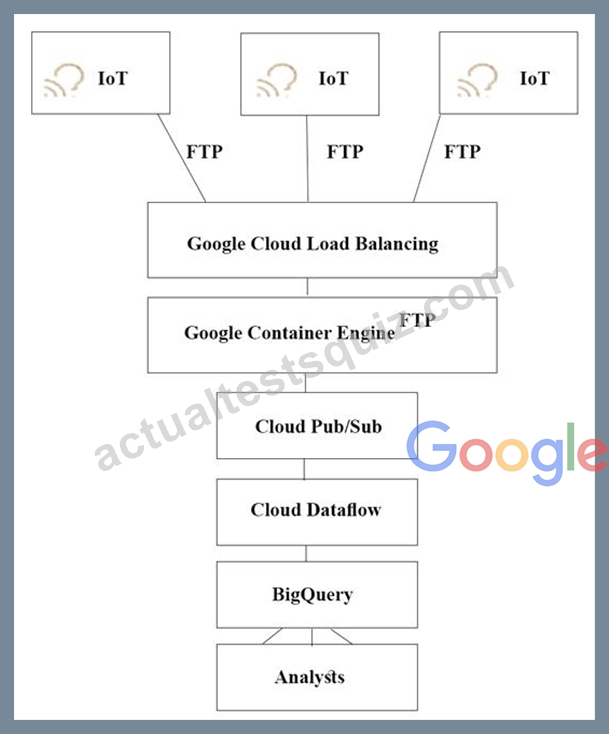
B)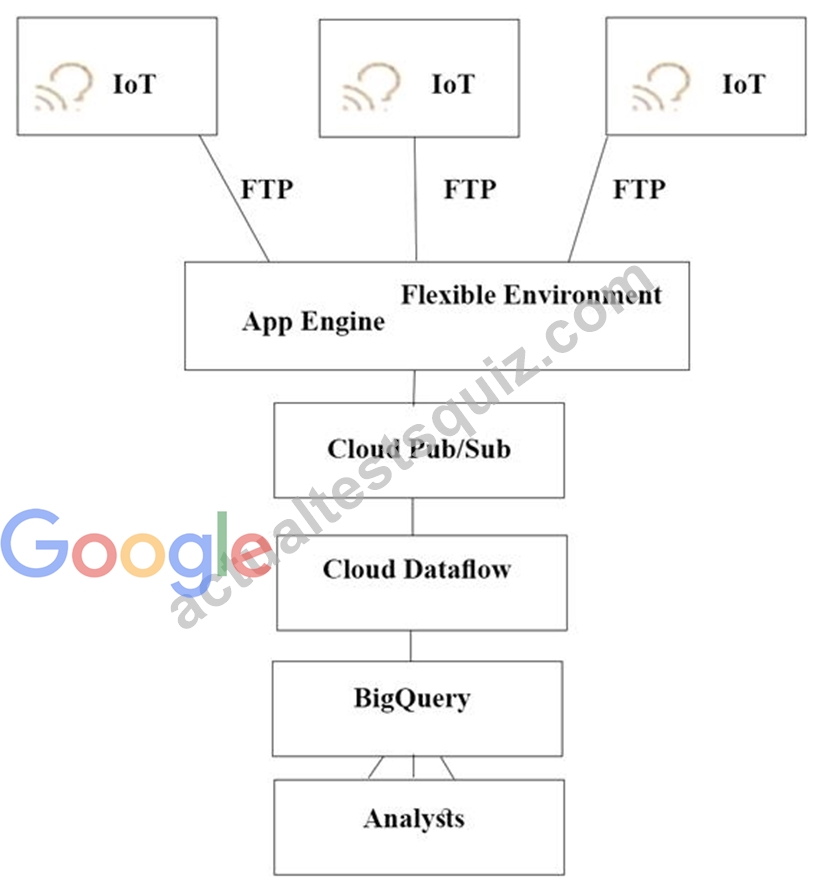
C)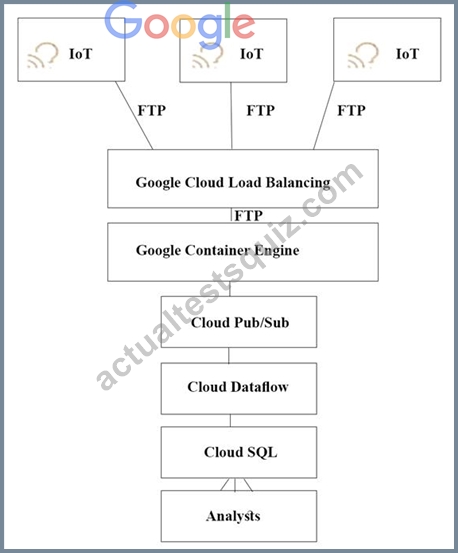
D)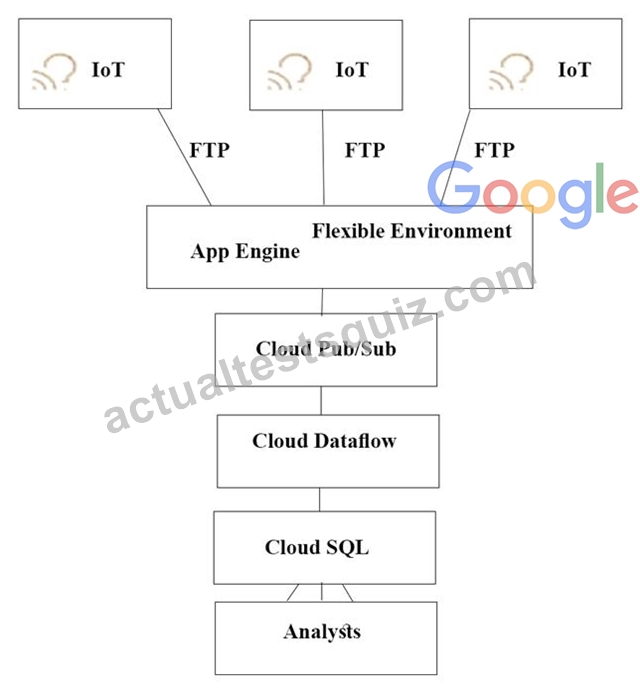
- A. Option D
- B. Option C
- C. Option B
- D. Option A
Answer: D
Explanation:
https://cloud.google.com/solutions/iot/
https://cloud.google.com/solutions/designing-connected-vehicle-platform
https://cloud.google.com/solutions/designing-connected-vehicle-platform#data_ingestion
http://www.eweek.com/big-data-and-analytics/google-touts-value-of-cloud-iot-core-for-analyzing-connected-car-data
https://cloud.google.com/solutions/iot/
The push endpoint can be a load balancer.
A container cluster can be used.
Cloud Pub/Sub for Stream Analytics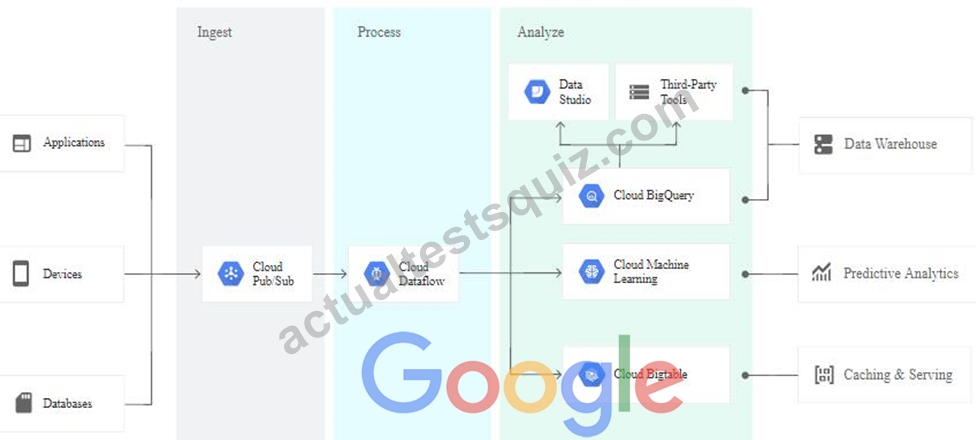
Reference:
https://cloud.google.com/solutions/iot/
https://cloud.google.com/solutions/designing-connected-vehicle-platform
https://cloud.google.com/solutions/designing-connected-vehicle-platform#data_ingestion
http://www.eweek.com/big-data-and-analytics/google-touts-value-of-cloud-iot-core-for-analyzing-connected-car-data
https://cloud.google.com/solutions/iot/
NEW QUESTION 123
For this question, refer to the Dress4Win case study. Dress4Win is expected to grow to 10 times its size in 1 year with a corresponding growth in data and traffic that mirrors the existing patterns of usage. The CIO has set the target of migrating production infrastructure to the cloud within the next 6 months. How will you configure the solution to scale for this growth without making major application changes and still maximize the ROI?
- A. Implement managed instance groups for the Tomcat and Nginx. Migrate MySQL to Cloud SQL, RabbitMQ to Cloud Pub/Sub, Hadoop to Cloud Dataproc, and NAS to Cloud Storage.
- B. Implement managed instance groups for Tomcat and Nginx. Migrate MySQL to Cloud SQL, RabbitMQ to Cloud Pub/Sub, Hadoop to Cloud Dataproc, and NAS to Compute Engine with Persistent Disk storage.
- C. Migrate the web application layer to App Engine, and MySQL to Cloud Datastore, and NAS to Cloud Storage. Deploy RabbitMQ, and deploy Hadoop servers using Deployment Manager.
- D. Migrate RabbitMQ to Cloud Pub/Sub, Hadoop to BigQuery, and NAS to Compute Engine with Persistent Disk storage. Deploy Tomcat, and deploy Nginx using Deployment Manager.
Answer: A
NEW QUESTION 124
Your application needs to process credit card transactions. You want the smallest scope of Payment Card Industry (PCI) compliance without compromising the ability to analyze transactional data and trends relating to which payment methods are used. How should you design your architecture?
- A. Streamline the audit discovery phase by labeling all of the virtual machines (VMs) that process PCI data.
- B. Enable Logging export to Google BigQuery and use ACLs and views to scope the data shared with the auditor.
- C. Create a tokenizer service and store only tokenized data.
- D. Create separate subnetworks and isolate the components that process credit card data.
- E. Create separate projects that only process credit card data.
Answer: C
Explanation:
Reference:
https://www.sans.org/reading-room/whitepapers/compliance/ways-reduce-pci-dss-audit-scope-tokenizing-cardho
NEW QUESTION 125
You are migrating third-party applications from optimized on-premises virtual machines to Google Cloud. You are unsure about the optimum CPU and memory options. The application have a consistent usage patterns across multiple weeks. You want to optimize resource usage for the lowest cost. What should you do?
- A. Create multiple Compute Engine instances with varying CPU and memory options. Install the cloud monitoring agent and deploy the third-party application on each of them. Run a load test with high traffic levels on the application and use the results to determine the optimal settings.
- B. Create an App Engine flexible environment, and deploy the third party application using a Docker file and a custom runtime. Set CPU and memory options similar to your application's current on-premises virtual machine in the app.yaml file.
- C. Create an instance template with the smallest available machine type, and use an image of the third party application taken from the current on-premises virtual machine. Create a managed instance group that uses average CPU to autoscale the number of instances in the group. Modify the average CPU utilization threshold to optimize the number of instances running.
- D. Create a Compute engine instance with CPU and Memory options similar to your application's current on-premises virtual machine. Install the cloud monitoring agent, and deploy the third party application. Run a load with normal traffic levels on third party application and follow the Rightsizing Recommendations in the Cloud Console
Answer: D
Explanation:
Create a Compute engine instance with CPU and Memory options similar to your application's current on-premises virtual machine. Install the cloud monitoring agent, and deploy the third party application. Run a load with normal traffic levels on third party application and follow the Rightsizing Recommendations in the Cloud Console
https://cloud.google.com/migrate/compute-engine/docs/4.9/concepts/planning-a-migration/cloud-instance-rightsizing?hl=en
NEW QUESTION 126
Your company is using BigQuery as its enterprise data warehouse. Data is distributed over several Google Cloud projects. All queries on BigQuery need to be billed on a single project. You want to make sure that no query costs are incurred on the projects that contain the data. Users should be able to query the datasets, but not edit them.
How should you configure users' access roles?
- A. Add all users to a group. Grant the group the roles of BigQuery jobUser on the billing project and BigQuery dataViewer on the projects that contain the data.
- B. Add all users to a group. Grant the group the role of BigQuery user on the billing project and BigQuery dataViewer on the projects that contain the data.
- C. Add all users to a group. Grant the group the roles of BigQuery dataViewer on the billing project and BigQuery jobUser on the projects that contain the data.
- D. Add all users to a group. Grant the group the roles of BigQuery dataViewer on the billing project and BigQuery user on the projects that contain the data.
Answer: A
NEW QUESTION 127
Your company's user-feedback portal comprises a standard LAMP stack replicated across two zones. It is deployed in the us-central1 region and uses autoscaled managed instance groups on all layers, except the database. Currently, only a small group of select customers have access to the portal. The portal meets a 99.99% availability SLA under these conditions However next quarter, your company will be making the portal available to all users, including unauthenticated users. You need to develop a resiliency testing strategy to ensure the system maintains the SLA once they introduce additional user load. What should you do?
- A. Create synthetic random user input, replay synthetic load until autoscale logic is triggered on at least one layer, and introduce "chaos" to the system by terminating random resources on both zones.
- B. Expose the new system to a larger group of users, and increase group ' size each day until autoscale logic is tnggered on all layers. At the same time, terminate random resources on both zones.
- C. Capture existing users input, and replay captured user load until autoscale is triggered on all layers. At the same time, terminate all resources in one of the zones.
- D. Capture existing users input, and replay captured user load until resource utilization crosses 80%. Also, derive estimated number of users based on existing users usage of the app, and deploy enough resources to handle 200% of expected load.
Answer: D
NEW QUESTION 128
For this question, refer to the Mountkirk Games case study. Mountkirk Games wants to migrate from their current analytics and statistics reporting model to one that meets their technical requirements on Google Cloud Platform.
Which two steps should be part of their migration plan? (Choose two.)
- A. Write a schema migration plan to denormalize data for better performance in BigQuery.
- B. Evaluate the impact of migrating their current batch ETL code to Cloud Dataflow.
- C. Load 10 TB of analytics data from a previous game into a Cloud SQL instance, and run test queries against the full dataset to confirm that they complete successfully.
- D. Integrate Cloud Armor to defend against possible SQL injection attacks in analytics files uploaded to Cloud Storage.
- E. Draw an architecture diagram that shows how to move from a single MySQL database to a MySQL cluster.
Answer: A,B
Explanation:
https://cloud.google.com/bigquery/docs/loading-data#loading_denormalized_nested_and_repeated_data
NEW QUESTION 129
You have found an error in your App Engine application caused by missing Cloud Datastore indexes. You have created a YAML file with the required indexes and want to deploy these new indexes to Cloud Datastore. What should you do?
- A. Point gcloud datastore create-indexesto your configuration file
- B. Create an HTTP request to the built-in python module to send the index configuration file to your application
- C. In the GCP Console, use Datastore Admin to delete the current indexes and upload the new configuration file
- D. Upload the configuration file to App Engine's default Cloud Storage bucket, and have App Engine detect the new indexes
Answer: A
NEW QUESTION 130
For this question, refer to the Mountkirk Games case study.
Mountkirk Games has deployed their new backend on Google Cloud Platform (GCP). You want to create a thorough testing process for new versions of the backend before they are released to the public. You want the testing environment to scale in an economical way. How should you design the process?
- A. Build stress tests into each component of your application using resources internal to GCP to simulate load.
- B. Create a scalable environment in GCP for simulating production load.
- C. Use the existing infrastructure to test the GCP-based backend at scale.
- D. Create a set of static environments in GCP to test different levels of load - for example, high, medium, and low.
Answer: B
Explanation:
From scenario: Requirements for Game Backend Platform
* Dynamically scale up or down based on game activity
* Connect to a managed NoSQL database service
* Run customize Linux distro
NEW QUESTION 131
Mountkirk Games needs to create a repeatable and configurable mechanism for deploying isolated application environments. Developers and testers can access each other's environments and resources, but they cannot access staging or production resources. The staging environment needs access to some services from production.
What should you do to isolate development environments from staging and production?
- A. Create one project for development, a second for staging and a third for production
- B. Create a network for development and test and another for staging and production
- C. Create one subnetwork for development and another for staging and production
- D. Create a project for development and test and another for staging and production
Answer: A
NEW QUESTION 132
A news feed web service has the following code running on Google App Engine. During peak load, users report that they can see news articles they already viewed.
What is the most likely cause of this problem?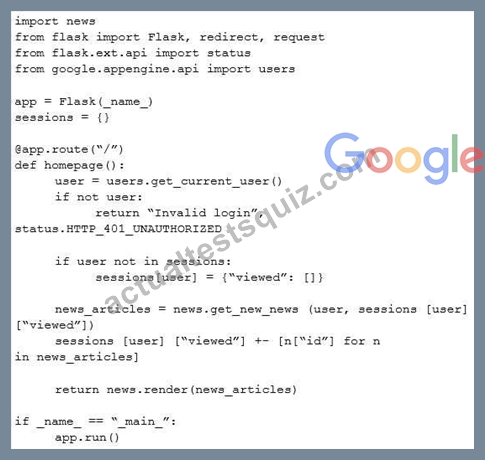
- A. The URL of the API needs to be modified to prevent caching
- B. The HTTP Expires header needs to be set to -1 stop caching
- C. The session variable is local to just a single instance
- D. The session variable is being overwritten in Cloud Datastore
Answer: D
Explanation:
Explanation/Reference: https://stackoverflow.com/questions/3164280/google-app-engine-cache-list-in-session-variable?
rq=1
NEW QUESTION 133
Google Cloud Platform resources are managed hierarchically using organization, folders, and projects. When Cloud Identity and Access Management (IAM) policies exist at these different levels, what is the effective policy at a particular node of the hierarchy?
- A. The effective policy is the policy set at the node and restricted by the policies of its ancestors
- B. The effective policy is the intersection of the policy set at the node and policies inherited from its ancestors
- C. The effective policy is the union of the policy set at the node and policies inherited from its ancestors
- D. The effective policy is determined only by the policy set at the node
Answer: C
Explanation:
https://cloud.google.com/resource-manager/docs/cloud-platform-resource-hierarchy
NEW QUESTION 134
For this question, refer to the Dress4Win case study. You are responsible for the security of data stored in Cloud Storage for your company, Dress4Win. You have already created a set of Google Groups and assigned the appropriate users to those groups. You should use Google best practices and implement the simplest design to meet the requirements.
Considering Dress4Win's business and technical requirements, what should you do?
- A. Assign predefined IAM roles to the Google Groups you created in order to enforce security requirements.
Utilize Google's default encryption at rest when storing files in Cloud Storage. - B. Assign custom IAM roles to the Google Groups you created in order to enforce security requirements.
Encrypt data with a customer-supplied encryption key when storing files in Cloud Storage. - C. Assign predefined IAM roles to the Google Groups you created in order to enforce security requirements.
Ensure that the default Cloud KMS key is set before storing files in Cloud Storage. - D. Assign custom IAM roles to the Google Groups you created in order to enforce security requirements.
Enable default storage encryption before storing files in Cloud Storage.
Answer: A
NEW QUESTION 135
Case Study: 7 - Mountkirk Games
Company Overview
Mountkirk Games makes online, session-based, multiplayer games for mobile platforms. They build all of their games using some server-side integration. Historically, they have used cloud providers to lease physical servers.
Due to the unexpected popularity of some of their games, they have had problems scaling their global audience, application servers, MySQL databases, and analytics tools.
Their current model is to write game statistics to files and send them through an ETL tool that loads them into a centralized MySQL database for reporting.
Solution Concept
Mountkirk Games is building a new game, which they expect to be very popular. They plan to deploy the game's backend on Google Compute Engine so they can capture streaming metrics, run intensive analytics, and take advantage of its autoscaling server environment and integrate with a managed NoSQL database.
Business Requirements
Increase to a global footprint.
Improve uptime - downtime is loss of players.
Increase efficiency of the cloud resources we use.
Reduce latency to all customers.
Technical Requirements
Requirements for Game Backend Platform
Dynamically scale up or down based on game activity.
Connect to a transactional database service to manage user profiles and game state.
Store game activity in a timeseries database service for future analysis.
As the system scales, ensure that data is not lost due to processing backlogs.
Run hardened Linux distro.
Requirements for Game Analytics Platform
Dynamically scale up or down based on game activity
Process incoming data on the fly directly from the game servers
Process data that arrives late because of slow mobile networks
Allow queries to access at least 10 TB of historical data
Process files that are regularly uploaded by users' mobile devices
Executive Statement
Our last successful game did not scale well with our previous cloud provider, resulting in lower user adoption and affecting the game's reputation. Our investors want more key performance indicators (KPIs) to evaluate the speed and stability of the game, as well as other metrics that provide deeper insight into usage patterns so we can adapt the game to target users.
Additionally, our current technology stack cannot provide the scale we need, so we want to replace MySQL and move to an environment that provides autoscaling, low latency load balancing, and frees us up from managing physical servers.
For this question, refer to the Mountkirk Games case study. You are in charge of the new Game Backend Platform architecture. The game communicates with the backend over a REST API.
You want to follow Google-recommended practices. How should you design the backend?
- A. Create an instance template for the backend. For every region, deploy it on a multi-zone managed instance group. Use an L7 load balancer.
- B. Create an instance template for the backend. For every region, deploy it on a single-zone managed instance group. Use an L7 load balancer.
- C. Create an instance template for the backend. For every region, deploy it on a multi-zone managed instance group. Use an L4 load balancer.
- D. Create an instance template for the backend. For every region, deploy it on a single-zone managed instance group. Use an L4 load balancer.
Answer: A
NEW QUESTION 136
You want to automate the creation of a managed instance group and a startup script to install the OS package dependencies. You want to minimize the startup time for VMs in the instance group.
What should you do?
- A. Create a custom VM image with all OS package dependencies. Use Deployment Manager to create the managed instance group with the VM image.
- B. Use Deployment Manager to create the managed instance group and Ansible to install the OS package dependencies.
- C. Use Terraform to create the managed instance group and a startup script to install the OS package dependencies.
- D. Use Puppet to create the managed instance group and install the OS package dependencies.
Answer: B
NEW QUESTION 137
For this question, refer to the TerramEarth case study.
To speed up data retrieval, more vehicles will be upgraded to cellular connections and be able to transmit data to the ETL process. The current FTP process is error-prone and restarts the data transfer from the start of the file when connections fail, which happens often. You want to improve the reliability of the solution and minimize data transfer time on the cellular connections. What should you do?
- A. Directly transfer the files to a different Google Cloud Regional Storage bucket location in us, eu, and asia using Google APIs over HTTP(S). Run the ETL process to retrieve the data from each Regional bucket.
- B. Use one Google Container Engine cluster of FTP servers. Save the data to a Multi-Regional bucket. Run the ETL process using data in the bucket.
- C. Directly transfer the files to different Google Cloud Multi-Regional Storage bucket locations in us, eu, and asia using Google APIs over HTTP(S). Run the ETL process using the data in the bucket.
- D. Use multiple Google Container Engine clusters running FTP servers located in different regions. Save the data to Multi-Regional buckets in us, eu, and asia. Run the ETL process using the data in the bucket.
Answer: A
Explanation:
Explanation
https://cloud.google.com/storage/docs/locations
NEW QUESTION 138
Your organization requires that metrics from all applications be retained for 5 years for future analysis in possible legal proceedings.
Which approach should you use?
- A. Grant the security team access to the logs in each Project
- B. Configure Stackdriver Monitoring for all Projects with the default retention policies
- C. Configure Stackdriver Monitoring for all Projects, and export to Google Cloud Storage
- D. Configure Stackdriver Monitoring for all Projects, and export to BigQuery
Answer: D
Explanation:
Explanation/Reference:
Explanation:
Stackdriver Logging provides you with the ability to filter, search, and view logs from your cloud and open source application services. Allows you to define metrics based on log contents that are incorporated into dashboards and alerts. Enables you to export logs to BigQuery, Google Cloud Storage, and Pub/Sub.
References: https://cloud.google.com/stackdriver/
NEW QUESTION 139
Your organization requires that metrics from all applications be retained for 5 years for future analysis in possible legal proceedings.
Which approach should you use?
- A. Grant the security team access to the logs in each Project
- B. Configure Stackdriver Monitoring for all Projects with the default retention policies
- C. Configure Stackdriver Monitoring for all Projects, and export to Google Cloud Storage
- D. Configure Stackdriver Monitoring for all Projects, and export to BigQuery
Answer: D
Explanation:
Stackdriver Logging provides you with the ability to filter, search, and view logs from your cloud and open source application services. Allows you to define metrics based on log contents that are incorporated into dashboards and alerts. Enables you to export logs to BigQuery, Google Cloud Storage, and Pub/Sub.
Reference: https://cloud.google.com/stackdriver/
NEW QUESTION 140
For this question, refer to the Helicopter Racing League (HRL) case study. HRL wants better prediction accuracy from their ML prediction models. They want you to use Google's AI Platform so HRL can understand and interpret the predictions. What should you do?
- A. Use Google Cloud's operations suite.
- B. Use Vision AI.
- C. Use Explainable AI.
- D. Use Jupyter Notebooks.
Answer: C
NEW QUESTION 141
Your solution is producing performance bugs in production that you did not see in staging and test environments. You want to adjust your test and deployment procedures to avoid this problem in the future.
What should you do?
- A. Deploy fewer changes to production
- B. Increase the load on your test and staging environments
- C. Deploy smaller changes to production
- D. Deploy changes to a small subset of users before rolling out to production
Answer: D
NEW QUESTION 142
You are tasked with building an online analytical processing (OLAP) marketing analytics and reporting tool. This requires a relational database that can operate on hundreds of terabytes of data. What is the Google- recommended tool for such applications?
- A. Cloud SQL, because it is a fully managed relational database
- B. Cloud Spanner, because it is globally distributed
- C. Cloud Firestore, because it offers real-time synchronization across devices
- D. BigQuery, because it is designed for large-scale processing of tabular data
Answer: D
Explanation:
Explanation
Explanation/Reference: https://cloud.google.com/files/BigQueryTechnicalWP.pdf
NEW QUESTION 143
You write a Python script to connect to Google BigQuery from a Google Compute Engine virtual machine. The script is printing errors that it cannot connect to BigQuery. What should you do to fix the script?
- A. Run your script on a new virtual machine with the BigQuery access scope enabled
- B. Install the latest BigQuery API client library for Python
- C. Install the bq component for gccloud with the command gcloud components install bq.
- D. Create a new service account with BigQuery access and execute your script with that user
Answer: C
NEW QUESTION 144
......
How to Prepare For Google Professional Cloud Architect Exam
Preparation Guide for Google Professional Cloud Architect Exam
Introduction
Google has designed a track for IT professionals to endorse as a cloud architect on the GCP platform. This accreditation program gives Google cloud professionals a way to endorse their skills. The evaluation relies on a meticulous exam using industry standard methodology to conclude whether or not a aspirant meets Google's proficiency standards.
According to Google, a Google Certified Professional Cloud Architect facilitate organizations to influence Google Cloud technologies. With a thorough understanding of cloud architecture and Google Cloud Platform, this individual can design, develop, and manage robust, secure, scalable, highly available, and dynamic solutions to drive business objectives.
Certification is evidence of your skills, expertise in those areas in which you like to work. If candidate wants to work on Google Professional Cloud Architect and prove his knowledge, Certification offered by Google. This Google Professional Cloud Architect Certification helps a candidate to validates his skills in Google Professional Cloud Architect Technology.
In this guide, we will cover the Google Professional Cloud Architect Exam, Google Professional Cloud Architect Certified Professionals salary and all aspects of the Google Professional Cloud Architect Certification.
New Professional-Cloud-Architect Exam Dumps with High Passing Rate: https://vceplus.actualtestsquiz.com/Professional-Cloud-Architect-test-torrent.html
