

Valid NSE 7 Network Security Architect NSE7_PBC-7.2 Dumps Ensure Your Passing
NSE7_PBC-7.2 Dumps Real Exam Questions Test Engine Dumps Training
To take the Fortinet NSE7_PBC-7.2 exam, candidates must have a strong understanding of networking and security fundamentals, as well as experience working with public cloud platforms such as Amazon Web Services (AWS), Microsoft Azure, and Google Cloud Platform (GCP). Candidates must also complete the Fortinet NSE 7 - Public Cloud Security 7.2 training course and pass the exam to earn the certification.
Fortinet NSE7_PBC-7.2 certification exam is a highly sought-after certification that validates the skills of cloud security professionals. Fortinet NSE 7 - Public Cloud Security 7.2 certification is designed to test the knowledge and skills of professionals who manage public cloud environments, particularly those using the Fortinet Security Fabric. Fortinet NSE 7 - Public Cloud Security 7.2 certification demonstrates that the professional is proficient in designing, implementing, and managing Fortinet’s cloud security solutions.
NEW QUESTION # 24
Refer to Exhibit: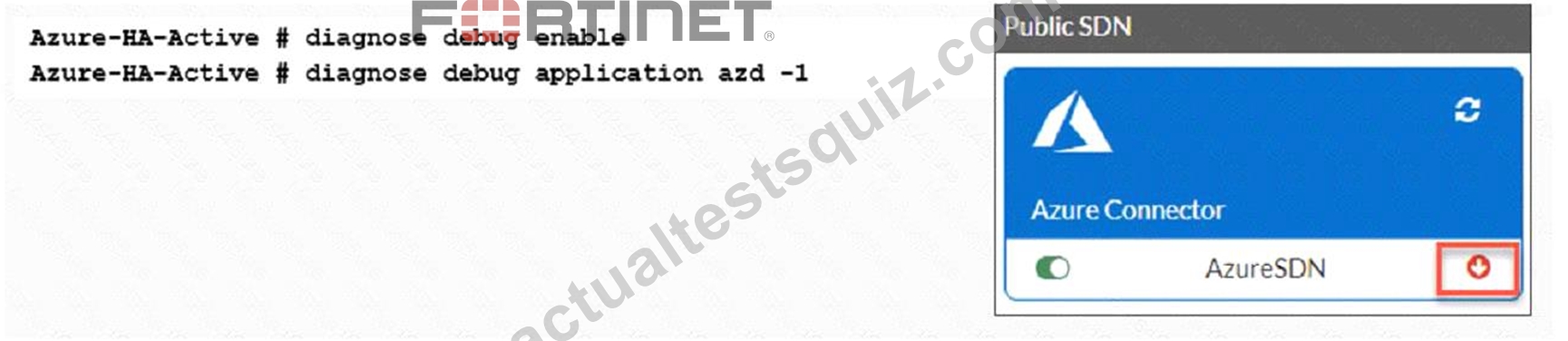
You are troubleshooting a Microsoft Azure SDN connector issue on your FortiGate VM in Azure Which three settings should you check while troubleshooting this problem? (Choose three.)
- A. use the diag sys va command.
- B. Ensure FortiGate portl has internet access
- C. Ensure IP address 169.254.169_254 is not blocked
- D. Use the show vdom command to see hidden VDOMs.
- E. Ensure FortiGate port4 can resolve DNS.
Answer: B,C,E
Explanation:
The three settings that should be checked while troubleshooting this problem are:
* Ensure FortiGate port4 can resolve DNS. This is because the Azure SDN connector requires DNS resolution to communicate with the Azure API1. If the FortiGate port4 cannot resolve DNS, the SDN connector will not be able to retrieve the Azure resources and display them in the GUI.
* Ensure FortiGate portl has internet access. This is because the Azure SDN connector requires internet access to communicate with the Azure API1. If the FortiGate portl does not have internet access, the SDNconnector will not be able to connect to the Azure cloud and display an error in the CLI.
* Ensure IP address 169.254.169_254 is not blocked. This is because the Azure SDN connector uses this IP address to obtain metadata information from the Azure instance2. If this IP address is blocked by a firewall policy or a network ACL, the SDN connector will not be able to get the required information and display an error in the CLI.
NEW QUESTION # 25
An administrator decides to use the Use managed identity option on the FortiGate SDN connector with Microsoft Azure However, the SDN connector is failing on the connection What must the administrator do to correct this issue?
- A. Make sure to add the Tenant ID on FortiGate side of the configuration
- B. Make sure to add the Client secret on FortiGate side of the configuration
- C. Make sure to set the type to system managed identity on FortiGate SDN connectorsettings
- D. Make sure to enable the system assigned managed identity on Azure
Answer: D
Explanation:
When an administrator decides to use the 'Use managed identity' option for the FortiGate SDN connector with Microsoft Azure and faces a connection failure, the correct action to take is:
C:Make sure to enable the system assigned managed identity on Azure.
* Managed Identity Configuration:The system assigned managed identity is a feature in Azure that provides an identity for the Azure service instance (in this case, the FortiGate SDN connector) within Azure Active Directory and eliminates the need for credentials to be stored in the configuration.
* Troubleshooting Connection Issues:If the SDN connector is failing to connect, it could be because the system assigned managed identity has not been enabled or configured properly in Azure for the FortiGate service.
References:Azure documentation on managed identities explains the need to enable and configure this feature for services to authenticate and interact securely with Azure resources.
NEW QUESTION # 26
You are using Red Hat Ansible to change the FortiGate VM configuration. What is the minimum number of files you must create and which file must you use to configure the target FortiGate IP address?
- A. Create two files and use the .yami file.
- B. Create one file and use the variable file
- C. Create two files and use the hosts file
- D. Create three files and use the .yarai file.
Answer: C
Explanation:
In using Red Hat Ansible for changing the configuration of a FortiGate VM, the minimum number of files you must create and the file to configure the target FortiGate IP address are: B. Create two files and use the hosts file.
Ansible Playbook File (YAML): The playbook file, which is typically a YAML file, contains the desired states and tasks that Ansible will execute on the target hosts.
Inventory File (Hosts): The inventory file, commonly named hosts, is where you define the target machines, including the FortiGate VM's IP address. Ansible uses this file to determine on which machines to run the playbook.
By creating these two files, you will have the necessary components to configure Ansible for the deployment. The playbook contains the automation tasks, and the hosts file lists the machines where those tasks will be executed.
NEW QUESTION # 27
Refer to the exhibit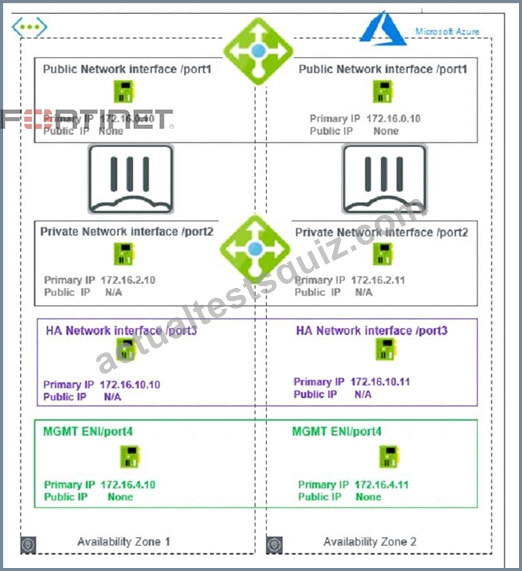
You are deploying two FortiGate VMS in HA active-passive mode with load balancers in Microsoft Azure Which two statements are true in this load balancing scenario? (Choose two.)
- A. You must add a route to the Microsoft VIP used for the health check.
- B. A dedicated management interface can be used for load balancing.
- C. The FortiGate public IP is the next-hop for all the traffic.
- D. An internal load balancer listener is the next-hop for outgoing traffic.
Answer: B,D
Explanation:
A is incorrect because the FortiGate public IP is not the next-hop for all the traffic. The FortiGate public IP is only used for incoming traffic from the internet. The Azure load balancer distributes the incoming traffic to the active FortiGate VM based on a health probe123. The FortiGate public IP is not used for outgoing traffic or internal traffic.
B is correct because an internal load balancer listener is the next-hop for outgoing traffic. The internal load balancer listener is configured with a floating IP address that is assigned to the active FortiGate VM. The internal load balancer listener also has a health probe to monitor the status of the FortiGate VMs123. The internal load balancer listener forwards the outgoing traffic to the internet through the public load balancer.
C is incorrect because you do not need to add a route to the Microsoft VIP used for the health check. The Microsoft VIP is an internal IP address that is used by the Azure load balancer to send health probes to the FortiGate VMs123. The Microsoft VIP is not reachable from outside the Azure network and does not require any routing configuration on the FortiGate VMs.
D is correct because a dedicated management interface can be used for load balancing. In this deployment, port4 is used as a dedicated management interface that connects to the management network3. The dedicated management interface can be used to access the FortiGate VMs for configuration and monitoring purposes. The dedicated management interface can also be used to synchronize the configuration and session information between the primary and secondary devices in an HA cluster2.
NEW QUESTION # 28
Refer to the exhibit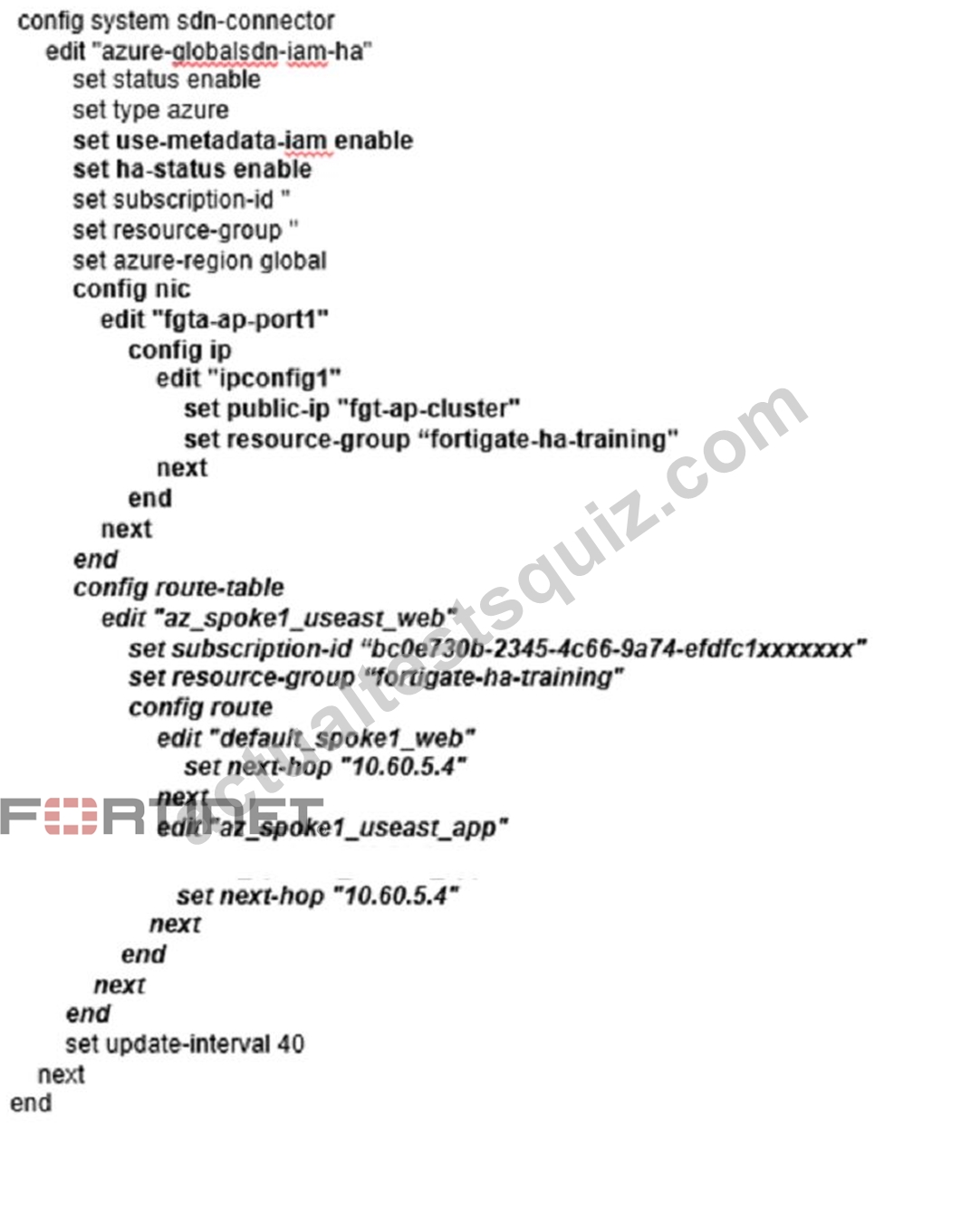
You deployed an HA active-passive FortiGate VM in Microsoft Azure.
Which two statements regarding this particular deployment are true? (Choose two.)
- A. By default, the configuration does not synchromze between the primary and secondary devices.
- B. During the failover, the passive FortiGate issues API calls to Azure
- C. Use the vdom-excepticn command to synchronize the configuration.
- D. There is no SLA for API calls from Microsoft Azure.
Answer: B,D
NEW QUESTION # 29
Which two attachments are necessary to connect a transit gateway to an existing VPC with BGP? (Choose two )
- A. A BGP attachment
- B. A connect attachment
- C. A GRE attachment
- D. A transport attachment
Answer: B,D
Explanation:
The correct answer is A and C. A transport attachment and a connect attachment are necessary to connect a transit gateway to an existing VPC with BGP.
According to the AWS documentation for Transit Gateway, a transit gateway is a network transit hub that connects VPCs and on-premises networks. To connect a transit gateway to an existing VPC with BGP, you need to do the following steps:
* Create a transport attachment. A transport attachment is a resource that connects a VPC or VPN to a transit gateway. You can specify the BGP options for the transport attachment, such as the autonomous system number (ASN) and the BGP peer IP address.
* Create a connect attachment. A connect attachment is a resource that enables you to use your own appliance to provide network services for traffic that flows through the transit gateway. You can use a connect attachment to route traffic between the transport attachment and your appliance using GRE tunnels and BGP.
The other options are incorrect because:
* A BGP attachment is not a valid type of attachment for a transit gateway. BGP is a protocol that enables dynamic routing between the transit gateway and the VPC or VPN.
* A GRE attachment is not a valid type of attachment for a transit gateway. GRE is a protocol that encapsulates packets for tunneling purposes. GRE tunnels are established between the connect attachment and your appliance.
[Transit Gateways - Amazon Virtual Private Cloud] : [Transit Gateway Connect - Amazon Virtual Private Cloud]
NEW QUESTION # 30
How does the immutable infrastructure strategy work in automation?
- A. It runs one idle and a single live environment for configuration changes.
- B. It runs two live environments for configuration changes.
- C. It runs one idle and two live environments for configuration changes.
- D. It runs a single live environment for configuration changes.
Answer: B
Explanation:
Immutable infrastructure is a DevOps approach that emphasizes the creation of disposable resources instead of modifying existing ones1. This approach helps to achieve stability, consistency, and predictability in IT operations by reducing the risk of configuration drift and eliminating stateful components1.
One way to implement immutable infrastructure is to use a blue-green deployment strategy, which runs two live environments for configuration changes2. The blue environment is the current production environment, while the green environment is the new version of the application or service. When the green environment is ready, the traffic is switched from blue to green, and the blue environment is destroyed or kept as a backup2. This way, there is no need to update or patch the existing infrastructure, but rather replace it with a new one.
Reference:
1: Immutable Infrastructure, Architecture, and its benefits
2: Introduction to Immutable Infrastructure - BMC Software | Blogs
NEW QUESTION # 31
You are troubleshooting an Azure SDN connectivity issue with your FortiGate VM.
Which two queries does that SDN connector use to interact with the Azure management API?
(Choose two.)
- A. The first query is targeted to IP address 8.8
- B. The first query is targeted to a special IP address to get a token.
- C. There is only one query initiating from FortiGate port1 -
- D. Some queries are made to manage public IP addresses.
Answer: B,D
Explanation:
The Azure SDN connector uses two types of queries to interact with the Azure management API.
The first query is targeted to a special IP address to get a token. This token is used to authenticate the subsequent queries. The second type of query is used to retrieve information about the Azure resources, such as virtual machines, network interfaces, network security groups, and public IP addresses. Some queries are made to manage public IP addresses, such as assigning or releasing them from the FortiGate VM.
NEW QUESTION # 32
Refer to the exhibit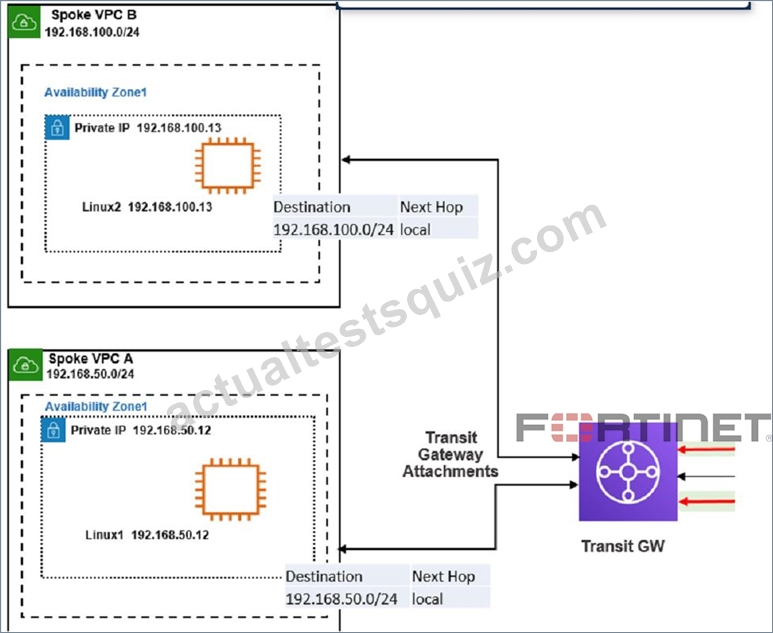
The exhibit shows a customer deployment of two Linux instances and their main routing table in Amazon Web Services (AWS). The customer also created a Transit Gateway (TGW) and two attachments Which two steps are required to route traffic from Linux instances to the TGWQ (Choose two.)
- A. In the main subnet routing table in VPC A and B, add a new route with destination 0_0.0.0/0, next hop TGW.
- B. In the TGW route table, add route propagation to 192.168.0 0/16
- C. In the TGW route table, associate two attachments.
- D. In the main subnet routing table in VPC A and B, add a new route with destination 0_0.0.0/0, next hop Internet gateway (IGW).
Answer: B,D
Explanation:
According to the AWS documentation for Transit Gateway, a Transit Gateway is a network transit hub that connects VPCs and on-premises networks. To route traffic from Linux instances to the TGW, you need to do the following steps:
In the TGW route table, associate two attachments. An attachment is a resource that connects a VPC or VPN to a Transit Gateway. By associating the attachments to the TGW route table, you enable the TGW to route traffic between the VPCs and the VPN.
In the main subnet routing table in VPC A and B, add a new route with destination 0_0.0.0/0, next hop TGW. This route directs all traffic from the Linux instances to the TGW, which can then forward it to the appropriate destination based on the TGW route table.
The other options are incorrect because:
In the TGW route table, adding route propagation to 192.168.0 0/16 is not necessary, as this is already the default route for the TGW. Route propagation allows you to automatically propagate routes from your VPC or VPN to your TGW route table.
In the main subnet routing table in VPC A and B, adding a new route with destination 0_0.0.0/0, next hop Internet gateway (IGW) is not correct, as this would bypass the TGW and send all traffic directly to the internet. An IGW is a VPC component that enables communication between instances in your VPC and the internet.
: [Transit Gateways - Amazon Virtual Private Cloud]
NEW QUESTION # 33
Which two statements are true about Transit Gateway Connect peers in anlPv4 BGP configuration'? (Choose two.)
- A. You must configure the second address from the IPv4 range on the device as the BGP IP address
- B. You cannot use IPv6 addresses
- C. The inside CIDR blocks are used for BGP peering
- D. You must specify a /29CIDR block from the 169.254.0.0/16 range
Answer: C,D
Explanation:
For Transit Gateway Connect peers in an IPv4 BGP configuration, the correct statements are:
The inside CIDR blocks are used for BGP peering (Option A): In a BGP configuration for Transit Gateway Connect, the inside CIDR blocks, typically within the 169.254.0.0/16 range, are designated for the BGP peering connections. These blocks are reserved for internal network protocols and are commonly used in AWS for automatic IP address assignment within managed networking services.
You must specify a /29 CIDR block from the 169.254.0.0/16 range (Option C): It is a requirement to specify a /29 CIDR block within the 169.254.0.0/16 range for setting up the network interfaces that facilitate BGP peering. This specific range allows for the necessary number of IP addresses to establish BGP sessions effectively between the transit gateway and on-premises or other virtual appliances.
NEW QUESTION # 34
Which two Amazon Web Services (AWS) features support east-west traffic inspection within the AWS cloud by the FortiGate VM? (Choose two.)
- A. A transit VPC
- B. A NAT gateway with an EIP
- C. A transit gateway with an attachment
- D. An Internet gateway with an EIP
Answer: A,C
Explanation:
Explanation
The correct answer is B and D. A transit gateway with an attachment and a transit VPC support east-west traffic inspection within the AWS cloud by the FortiGate VM.
According to the Fortinet documentation for Public Cloud Security, a transit gateway is a network transit hub that connects VPCs and on-premises networks. A transit gateway attachment is a resource that connects a VPC or VPN to a transit gateway.By using a transit gateway with an attachment, you can route traffic from your spoke VPCs to your security VPC, where the FortiGate VM can inspect the traffic1.
A transit VPC is a VPC that serves as a global network transit center for connecting multiple VPCs, remote networks, and virtual private networks (VPNs).By using a transit VPC, you can deploy the FortiGate VM as a virtual appliance that provides network security and threat prevention for your VPCs2.
The other options are incorrect because:
A NAT gateway with an EIP is a service that enables instances in a private subnet to connect to the internet or other AWS services, but prevents the internet from initiating a connection with those instances.A NAT gateway with an EIP does not support east-west traffic inspection within the AWS cloud by the FortiGate VM3.
An Internet gateway with an EIP is a horizontally scaled, redundant, and highly available VPC component that allows communication between instances in your VPC and the internet.An Internet gateway with an EIP does not support east-west traffic inspection within the AWS cloud by the FortiGate VM4.
1:Fortinet Documentation Library - Deploying FortiGate VMs on AWS2: [Fortinet Documentation Library - Transit VPC on AWS]3: [NAT Gateways - Amazon Virtual Private Cloud]4: [Internet Gateways - Amazon Virtual Private Cloud]
NEW QUESTION # 35
What is the main advantage of using SD-WAN Transit Gateway Connect over traditional SD- WAN?
- A. You can use BGP over IPsec for maximum throughput
- B. You can use GRE-based tunnel attachments
- C. You can combine it with IPsec to achieve higher bandwidth
- D. It eliminates the use of ECMP
Answer: B
Explanation:
Simplified and Scalable Connectivity: Transit Gateway Connect allows you to establish GRE tunnels to your SD-WAN appliances natively within the AWS network. This eliminates the complexity of managing individual IPsec VPN connections, especially as your cloud presence grows.
Potential for Enhanced Performance: GRE offers lower overhead compared to IPsec, which can result in higher throughput for bandwidth-intensive SD-WAN applications.
Flexibility: While IPsec is supported for scenarios requiring strong encryption, the focus on GRE highlights the performance and scalability benefits that are often prioritized when integrating SD- WAN with AWS.
Dynamic Routing: The integration with BGP further streamlines network management by automating route updates and distribution.
Addressing the IPsec Consideration: It's important to acknowledge that SD-WAN Transit Gateway Connect does support IPsec. If your question is specifically framed within the context of Fortinet's FCSS 7.2 materials and they emphasize the hybrid usage of GRE and IPsec, then a modified answer might be appropriate:
NEW QUESTION # 36
Refer to the exhibit. You are tasked to deploy a FortiGate VM with private and public subnets in Amazon Web Services (AWS).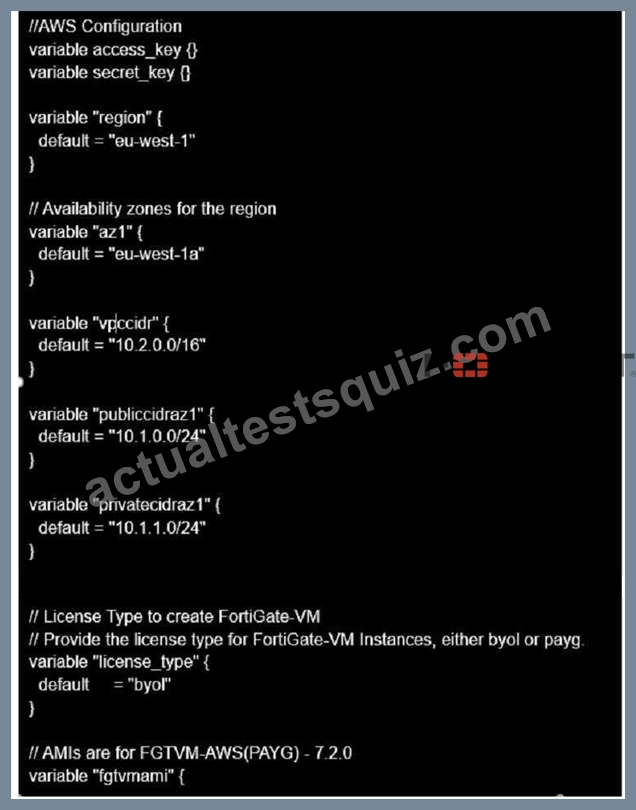
You examined the variables.tf file.
What will be the final result after running the terraform init and terraform apply commands?
- A. Terraform will deploy a FortiGate VM in the eu-West-Ia region with private and public subnets.
- B. Terraform will not deploy a FortiGate VM
- C. Terraform will deploy a FortiGate VM in the eu-West-1a region with two subnets and byol license.
- D. Terraform will deploy a FortiGate VM in the eu-West-Ia region without any subnets.
Answer: A
Explanation:
The variables.tf file shows that the FortiGate VM will be deployed in the eu-West-Ia region with private and public subnets. The region variable is set to "eu-west-1" and the availability_zone variable is set to "eu-west-1a". The vpc_id variable is set to "vpc-0e9d6a6f" and the subnets variable is set to a list of two subnet IDs: "subnet-0f9d6a6f" and "subnet-1f9d6a6f". The license_type variable is set to "on-demand" and the ami_id variable is set to "ami-0e9d6a6f".
NEW QUESTION # 37
You need to deploy FortiGate VM devices in a highly available topology in the Microsoft Azure cloud. The following are the requirements of your deployment:
- Two FortiGate devices must be deployed; each in a different availability zone.
- Each FortiGate requires two virtual network interfaces: one will connect to a public subnet and the other will connect to a private subnet.
- An external Microsoft Azure load balancer will distribute ingress traffic to both FortiGate devices in an active- active topology.
- An internal Microsoft Azure load balancer will distribute egress traffic from protected virtual machines to both FortiGate devices in an active-active topology.
- Traffic should be accepted or denied by a firewall policy in the same way by either FortiGate device in this topology.
Which FortiOS CLI configuration can help reduce the administrative effort required to maintain the FortiGate devices, by synchronizing firewall policy and object configuration between the FortiGate devices?
- A. config system sdn-connector
- B. config system session-sync
- C. config system ha
- D. config system auto-scale
Answer: C
Explanation:
FTG HA Active/Active requires the following configuration to sync the session by FGSP config system ha set session-pickup enable set session-pickup-connectionless enable set session-pickup-nat enable set session-pickup-expectation enable set override disable end config system cluster-sync edit 0 set peerip 10.0.1.x set syncvd "root" next end
NEW QUESTION # 38
How does Terraform keep track of provisioned resources?
- A. It uses the terraform. tfvars file.
- B. It uses the terraform. tf state file
- C. It uses the database. tf file.
- D. Terraform does not keep the state of resources created
Answer: B
Explanation:
Terraform manages and tracks the state of infrastructure resources through a file known asterraform.tfstate.
This file is automatically created by Terraform and is updated after the application of a Terraform plan to capture the current state of the resources.
* State File Purpose:Theterraform.tfstatefile contains a JSON object that records the IDs and properties of resources Terraform manages, so that it can map real-world resources to your configuration, keep track of metadata, and improve performance for large infrastructures.
* State File Management:This file is crucial for Terraform to perform resource updates, deletions, and for creating dependencies. It's essentially the 'source of truth' for Terraform about your managed infrastructure and services.
References:This behavior is documented in Terraform's official documentation, which explains how the terraform.tfstatefile is used to keep track of the infrastructure Terraform is managing.
NEW QUESTION # 39
You have previously deployed an Amazon Web Services (AWS) transit virtual private cloud (VPC) with a pair of FortiGate firewalls (VM04 / c4.xlarge) as your security perimeter. You are beginning to see high CPU usage on the FortiGate instances.
Which action will fix this issue?
- A. Convert the transit VPC firewalls into an auto-scaling group and launch additional EC2 instances in that group.
- B. Migrate the transit VPNs to new and larger instances (VM08 / c4.2xlarge).
- C. Convert the c4.xlarge instances to m4.xlarge instances.
- D. Convert from IPsec tunnels to generic routing encapsulation (GRE) tunnels, for the VPC peering connections.
Answer: A
Explanation:
Multiple FortiGate-VM instances form an Auto Scaling group to provide highly efficient clustering at times of high workloads. FortiGate-VM instances can be scaled out automatically according to predefined workload levels.
NEW QUESTION # 40
......
Fortinet NSE7_PBC-7.2: Selling NSE 7 Network Security Architect Products and Solutions: https://vceplus.actualtestsquiz.com/NSE7_PBC-7.2-test-torrent.html
