

Check Real VMware 3V0-22.25 Exam Question for Free (2026)
Get Ready to Boost your Prepare for your 3V0-22.25 Exam with 62 Questions
NEW QUESTION # 22
A "Dev-Ops" team complains that their "CI/CD-Build" VMs are constantly appearing in the
"Oversized" reclamation list because they run at 100% CPU for 1 hour a day but are idle the rest of the time. They do not want these downsized.
What is the correct configuration strategy to stop VCF Operations from recommending downsizing for these specific VMs?
- A. Delete the VMs from VCF Operations.
- B. Create a Custom Group for "CI/CD VMs", create a specific Policy that disables "Rightsizing" (or sets it to be extremely conservative), and assign that Policy to the Custom Group.
- C. Use the "Exclusion" tag in vCenter.
- D. Disable the "Capacity Engine" globally.
Answer: B
NEW QUESTION # 23
A storage administrator notices that while VCF Operations successfully deletes the "Powered Off VMs" from the vCenter inventory, the underlying VMDK files sometimes remain on the datastore.
What is the recommended "Day 2" operational task to clean up these leftovers?
- A. Restart the vCenter Server to clear the file locks.
- B. Manually browse the datastore and delete folders.
- C. Navigate to the "Orphaned Disks" tab within the Reclaim workbench. VCF Operations identifies these lingering files as orphaned (files with no parent VM) and provides a dedicated workflow to delete them safely.
- D. Run the "Delete VM" command again.
Answer: C
NEW QUESTION # 24
An administrator was asked to prepare a report that groups VMs into buckets by CPU Ready % such as 0-2%,
2-5%, 5-10%, and > 10% to visualize the spread. Which view should be used to provide such visualization?
- A. List View
- B. Distribution View
- C. Trend View
- D. Summary View
Answer: B
Explanation:
The correct view type is Distribution View . The requirement is not simply to list VMs or plot a time-series trend; it is to group VM metric values into defined ranges or "buckets" so the administrator can visualize how many VMs fall into each CPU Ready % band. VCF Operations documentation defines Distribution Views as views that provide aggregated data about resource distribution in the monitored environment. When used in dashboards, the administrator can click a section of a pie chart, bar chart, or donut chart to view the list of objects filtered by that selected segment . This directly fits the requested CPU Ready % spread visualization.
The same configuration supports Manual Distribution , where the administrator specifies the number of buckets and the minimum and maximum values of each bucket . That is the exact model required for ranges such as 0-2%, 2-5%, 5-10%, and greater than 10%. List View is tabular, Trend View is time-based, and Summary View is not intended for bucketed metric distribution. Reference topic: Objective 4.10 - Creating Custom Dashboards, Views and Reports / Distribution Views / Manual Distribution Buckets .
NEW QUESTION # 25
A VCF Operator is investigating a storage outage. The raw logs show cryptic messages like:
ScsiDeviceIO: 2338: Cmd(0x439d4) 0x1a, CmdSN 0x0 from world 0 to dev "naa.600..." failed H:0x0 D:0x2 P:0x0 The operator struggles to understand what H:0x0 D:0x2 means.
How does VCF Operations for Logs primarily assist in decoding these technical error codes for faster root cause analysis?
- A. It uses AI to rewrite the log in English.
- B. It opens a support ticket with the storage vendor automatically.
- C. It highlights the text in red but offers no translation.
- D. The VMware vSphere Content Pack automatically parses these hex codes into human-readable Extracted Fields (e.g., scsi_sense_code, scsi_host_status), often creating a summary field like "Check Condition" or mapping them to specific "Storage Error" event types.
Answer: D
NEW QUESTION # 26
An adapter instance stays in the "Warning" state. The hover-text error message states: "Collection cycle time exceeded".
What does this specific error imply about the health of the integration?
- A. The adapter is in Maintenance Mode.
- B. The target system is too large (too many objects) or responding too slowly, causing the data collection to take longer than the configured interval (e.g., taking 7 minutes to complete a 5-minute poll). This leads to gaps in data.
- C. The network has high packet loss.
- D. The credentials are about to expire.
Answer: B
NEW QUESTION # 27
An operator is investigating a "vSAN Object Inaccessible" issue. The VCF Operations metric dashboard shows a spike in latency but no specific error code. The operator needs to find the exact SCSI sense codes and VMkernel error messages generated by the ESXi hosts at the time of the event.
# Troubleshooting Workflow
Step 1: Identify Time Range (10:00 - 10:15).
Step 2: ???
Step 3: Correlate Error Code with KB Article.
Which action represents the correct usage of VCF Operations for Logs in this workflow?
- A. Open the "Metric Chart" in VCF Operations for Logs to view the IOPS rate.
- B. Reboot the ESXi hosts to generate a fresh crash dump for analysis.
- C. Use the "Interactive Analytics" tab in VCF Operations for Logs to query for text contains
"ScsiDeviceIO" or appname contains "vmkernel" during the target time window. - D. Use SDDC Manager to download the "SoS Report" and manually grep the text files.
Answer: C
NEW QUESTION # 28
During the "Validation" phase of a VCF bring-up, the VCF Installer Appliance reports a "Critical Error" regarding Network Connectivity.
# Validation Report
Task: Validate ESXi Hosts
Status: Failed
Error: "Host sfo-m01-esx01.corp.local cannot resolve vCenter FQDN sfo-m01-vc01.corp.local." Which built-in capability of the VCF Installer Appliance should the engineer use to deep-dive into this error and collect diagnostic bundles?
- A. The "SoS" (Supportability and Serviceability) utility via SSH.
- B. The "Host Client" UI on the ESXi host.
- C. The "Aria Operations for Logs" agent.
- D. The "vCenter Support Assistant" plugin.
Answer: A
NEW QUESTION # 29
A VCF Operations for Logs cluster consisting of 3 nodes is experiencing slow query performance and ingestion lag. The administrator decides to scale out the cluster by adding 3 new nodes.
What is the operational impact on the existing historical log data after the new nodes are added?
- A. The existing data remains on the original 3 nodes; only new incoming logs are distributed across the 6 nodes. Historical searches will query the old nodes for old data and all nodes for new data.
- B. The existing data is automatically rebalanced across all 6 nodes immediately after expansion.
- C. The new nodes cannot accept data until the existing data is fully replicated to them, causing a downtime window.
- D. The existing data must be manually migrated to the new nodes using the "Data Rebalance Tool".
Answer: A
NEW QUESTION # 30
Which prerequisite is required for VCF Operations to successfully execute a "Power Off" or "Delete" action on a VM from the Reclaim workbench?
- A. The vCenter Adapter Instance must be configured with "Enable Actions = True", and the credential used by the adapter must have the necessary vSphere permissions (e.g., VirtualMachine.Interact.PowerOff) to perform the task.
- B. The user must be logged in as root.
- C. The VCF Operations "Action Service" must be stopped.
- D. The Cloud Proxy must have SSH enabled.
Answer: A
NEW QUESTION # 31
An operator reports that they cannot log in to VCF Operations using their domain credentials ([email protected]).
# Diagnostic Data
- Local admin@local login: Success
- SDDC Manager login with [email protected]: Failed
- Error Message: "Identity Broker Service Unavailable"
# Service Status (SDDC Manager VM)
vcf-idb-service: Stopped
postgresql: Running
What is the impact of the vcf-idb-service being stopped on the VCF environment?
- A. Authentication for VCF Operations, SDDC Manager, and other integrated components using federated/external identities will fail. Local emergency accounts may still work if they bypass the broker (depending on config), but general SSO is down.
- B. vCenter Server will disconnect all ESXi hosts.
- C. All VMs in the Workload Domains will lose network connectivity.
- D. VCF Operations will stop collecting metrics from vCenter.
Answer: A
NEW QUESTION # 32
An administrator is faced with 50,000 log entries generated during a 5-minute application crash window. Searching line-by-line is impossible.
Which VCF Operations for Logs feature allows the administrator to collapse these 50,000 lines into a small list of Unique Patterns, instantly revealing the single "Unhandled Exception" anomaly hidden among the noise?
- A. The "Export to Excel" function.
- B. The "Text" filter.
- C. The "Event Types" (or Intelligent Grouping) tab. This feature uses machine learning to cluster similar log messages (ignoring variable parts like timestamps or IP addresses) into canonical patterns, presenting the volume of each pattern to highlight outliers.
- D. The "Syslog Forwarding" rule.
Answer: C
NEW QUESTION # 33
A user complains that they cannot find logs for a specific ESXi host in VCF Operations for Logs. The administrator checks the ESXi host configuration and sees: Syslog.global.logHost = udp://loginsight.corp.local:514 A packet capture on the Log Insight node shows packets arriving from the ESXi host IP on port 514.
Why are the logs still not searchable in the UI?
- A. The ESXi host is in Maintenance Mode.
- B. The Log Insight license has expired.
- C. The logs are being dropped because the ESXi host's time is significantly skewed (Time Drift) relative to the Log Insight cluster, putting the timestamps outside the query window.
- D. The indexer service is stopped.
Answer: C
NEW QUESTION # 34
Refer to the exhibit.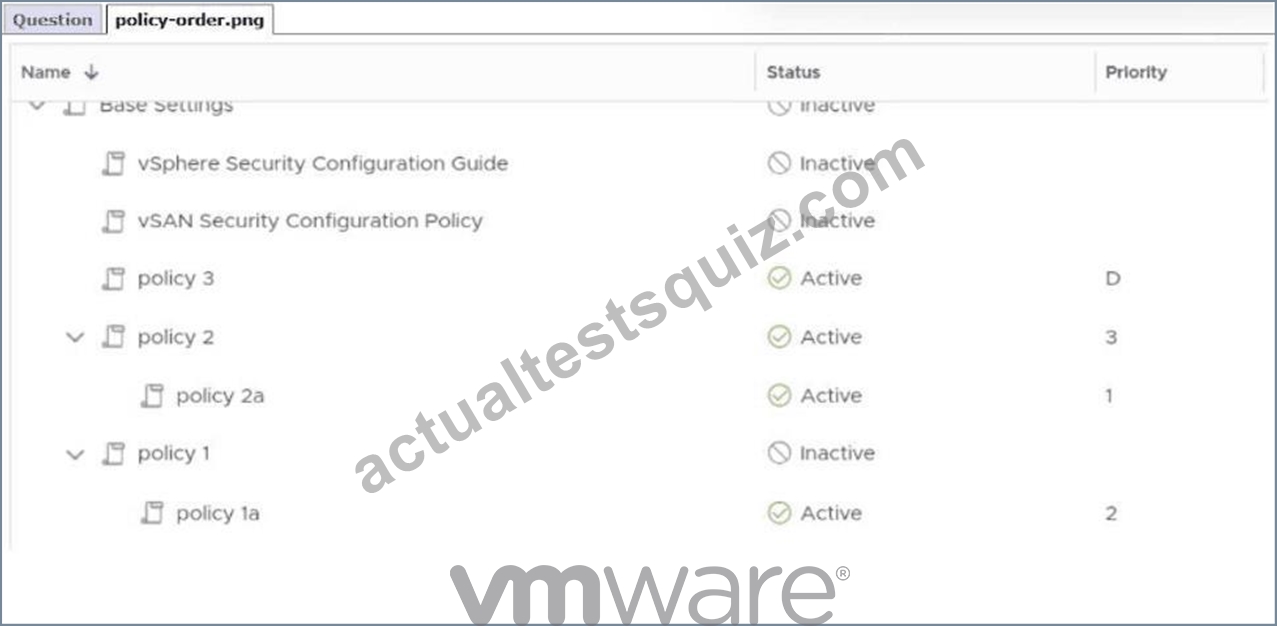
A workload named Workload-01 is a member of four custom groups:
* CG-01
* CG-02
* CG-03
* CG-04
Custom group CG-01 has been assigned to policy 1 .
Custom group CG-04 has been assigned to policy 1a .
Custom group CG-02 has been assigned to policy 2 .
Custom group CG-03 has been assigned to policy 2a .
Which policy is applied to Workload-01 ?
- A. policy 1
- B. policy 1a
- C. policy 2
- D. policy 2a
Answer: D
Explanation:
The applied policy is policy 2a because VCF Operations resolves multiple policy assignments by using active policy priority , not by custom group name, policy inheritance tree location, or alphabetical order. The exhibit shows policy 2a as active with priority 1 , policy 1a as active with priority 2 , and policy 2 as active with priority 3 . policy 1 is inactive, so it is not eligible to become the effective policy for the workload. VCF Operations documentation states that policies are applied in priority order as shown on the Active Policies tab, and that priority 1 is the highest priority. It further states that when an object is a member of multiple object groups and each group has a different policy assigned, VCF Operations associates the highest ranking policy with that object . Therefore, even though Workload-01 belongs to all four custom groups, the effective policy is the active policy with the highest rank: policy 2a . Reference topic: Objective 4.5 - Managing VCF Operations with VCF Policy / Policy Hierarchy / Policy Assignment / Active Policy Priority .
NEW QUESTION # 35
An analyst is viewing a query result that shows 10,000 events. They want to break down these events to see which Hostname is generating the most logs, rather than seeing a flat list.
Which Interactive Analytics feature transforms the view into this summarized format?
- A. Switch to the "Chart" tab (or check the visual header) and set the "Group By" (or Break By) field to
"hostname". This aggregates the event count by host and displays the top talkers (e.g., Host A: 5000, Host B: 2000), allowing the analyst to identify the noisy source immediately. - B. Type group=hostname in the search bar.
- C. Click "Export to PDF".
- D. Change the "Chart Type" to "Pie Chart" without changing settings.
Answer: A
NEW QUESTION # 36
Which specific network requirement is critical for the stability of a VCF Operations Continuous Availability (CA) cluster stretched between two data centers?
- A. The link must support Multicast routing for GemFire heartbeats.
- B. Round-Trip Time (RTT) latency between the two fault domains must be less than 10ms (ideally
<5ms). - C. A dedicated 100Gbps link is required.
- D. The connection must support Jumbo Frames (MTU 9000).
Answer: B
NEW QUESTION # 37
Which specific input in the "Depreciation" cost driver configuration determines how quickly the capital cost of a server is amortized to zero in the VCF Operations cost calculations?
- A. The "Depreciation Period" (e.g., 3 Years, 5 Years). The system divides the Purchase Price by this period (in months) to determine the monthly hardware cost allocated to the cluster.
- B. The "Discount Rate".
- C. The "Utilization Spike".
- D. The "Server Model".
Answer: A
NEW QUESTION # 38
......
Use Free 3V0-22.25 Exam Questions that Stimulates Actual EXAM : https://vceplus.actualtestsquiz.com/3V0-22.25-test-torrent.html
